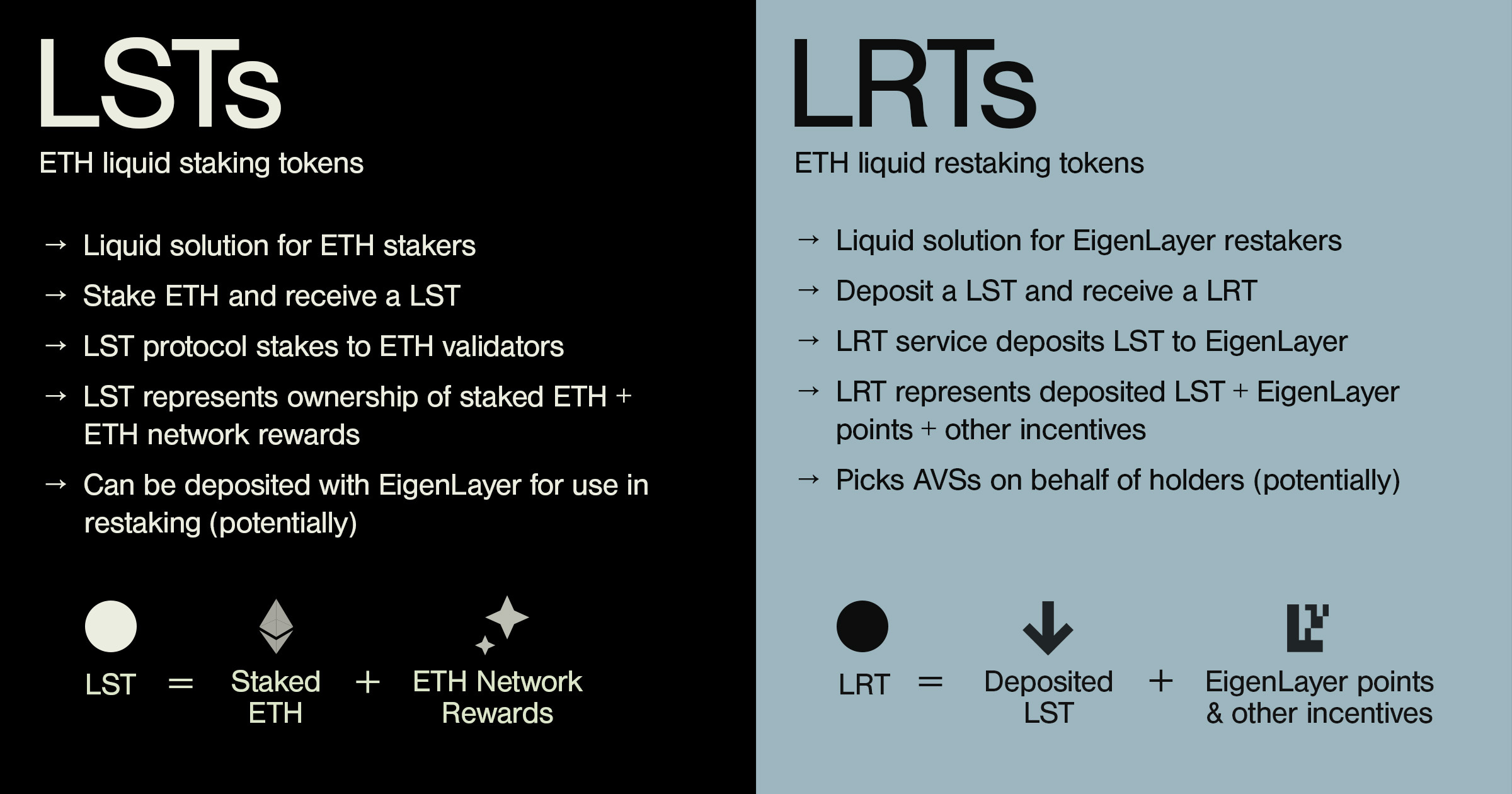
How LRT Yield Works
Liquid restaking tokens (LRTs) have shifted the yield narrative from passive holding to active validation. While Liquid Staking Tokens (LSTs) primarily offer rewards for securing the Ethereum network, LRTs layer on top of that foundation by restaking those assets through protocols like EigenLayer. This creates a composite yield structure that combines base staking rewards with additional returns from actively validated services (AVSs).
The distinction matters because it changes how you evaluate risk. An LST yield is relatively straightforward, tied directly to Ethereum's consensus layer. An LRT yield is multi-sourced, pulling from staking rewards, protocol points, and potential slashing events associated with the restaking infrastructure. This complexity means the total return is not just higher; it is structurally different.
Understanding this landscape is the first step in analyzing infrastructure risks. The yield is not a static promise but a dynamic output of multiple interconnected protocols. We will break down these components to see where the actual returns come from and where the hidden vulnerabilities lie.
Infrastructure Risks in Restaking Protocols
Restaking protocols like EigenLayer introduce a layer of complexity that fundamentally changes how capital is secured. While the yield potential is attractive, the underlying infrastructure relies on nested smart contracts and shared security models that create unique points of failure. Understanding these mechanical risks is essential before allocating capital to Liquid Restaking Tokens (LRTs).
Liquidity Fragmentation and Withdrawal Queues
LRTs do not hold liquid ETH directly in a simple wallet; they represent a claim on staked ETH that is often locked in withdrawal queues. When the Ethereum beacon chain processes withdrawals, it does so in batches. If multiple LRT protocols attempt to withdraw simultaneously, the queue depth increases, delaying access to capital.
This fragmentation means that during periods of high volatility, you may not be able to exit a position quickly. The liquidity you see on exchanges is often synthetic or backed by secondary markets, not the underlying staked asset. A sudden rush to exit can expose the gap between the token price and the actual value of the underlying staked ETH.
Smart Contract Nesting and Attack Surfaces
Every LRT protocol adds its own smart contracts on top of the base staking layer. This nesting creates a larger attack surface. If the LRT’s smart contract has a vulnerability, an attacker can exploit it to drain funds, even if the underlying Ethereum staking contract is secure.
Gauntlet’s risk framework for LRTs highlights that the complexity of these nested systems increases the difficulty of auditing. Each additional layer of logic—such as yield optimization or restaking delegation—introduces potential bugs or economic exploits. The interdependence of these contracts means that a failure in one protocol can cascade, affecting the stability of the entire LRT ecosystem.
Shared Security Risks
Restaking allows staked ETH to secure multiple services simultaneously. While this amplifies yield, it also amplifies risk. If one of the restaked services (like an oracle or rollup) is compromised, the economic security provided by the staked ETH can be slashed. This means your underlying ETH could be penalized not just for Ethereum network rules, but for the failures of third-party protocols.
This shared security model creates a correlation risk. Diversification across different LRTs may not protect you if they all rely on the same underlying Ethereum staking infrastructure. A systemic issue in Ethereum’s consensus layer or a widespread bug in a common restaking library can impact all LRTs simultaneously.
| Feature | Infrastructure Risk |
|---|---|
| Withdrawal Speed | Delayed by beacon chain queues and protocol-specific limits |
| Security Model | Nested contracts increase attack surface and audit complexity |
| Capital Availability | Liquidity fragmentation can lead to slippage during exits |
| Slashing Exposure | Shared security means third-party failures can slash your ETH |
How to Verify LRT Smart Contract Security
Evaluating the security posture of Liquid Restaking Token (LRT) protocols requires looking beyond marketing claims and examining the engineering rigor behind the code. Because LRTs involve complex layers of nesting—where restaked assets are used as collateral for new positions—the risk surface expands significantly with each layer of abstraction. A single vulnerability in a lower-level contract can cascade through the entire yield structure, making verification a critical step in infrastructure due diligence.
Audit Frequency and Scope
Not all audits are created equal. You should prioritize protocols that undergo regular, comprehensive audits by reputable firms, rather than relying on a single initial review. Look for evidence of continuous integration testing and post-deployment monitoring. Gauntlet’s risk framework emphasizes the importance of understanding how code changes impact the overall system stability over time. An audit is not a permanent seal of approval; it is a snapshot of security at a specific point in time. Protocols that publish their audit reports and actively address findings demonstrate a higher commitment to long-term safety.
Bug Bounty Programs
A robust bug bounty program acts as a secondary line of defense, incentivizing independent researchers to find vulnerabilities before malicious actors do. Check for active programs on platforms like Immunefi or HackerOne. The size of the bounty pool and the clarity of the scope are good indicators of the protocol’s seriousness about security. A well-funded bounty program can uncover edge cases that even the most thorough internal audits might miss, providing an additional layer of verification for your risk assessment.
The Risks of Code Nesting
The core complexity of LRTs lies in their nested architecture. When you restake an LRT, you are essentially using a token that already represents staked assets as collateral for further staking. This creates a dependency chain where the security of the top-level token is inextricably linked to the security of all underlying contracts. If the underlying validator or staking contract is compromised, the value of the nested LRT is directly impacted. Understanding this dependency is crucial for assessing the true risk-adjusted returns of any LRT strategy.
Evaluating yield sustainability and tools
Not all LRT yields are created equal. The infrastructure behind these protocols determines whether returns are sustainable or artificially inflated. To assess this, we look at the multi-layer structure of LRTs, which combines base staking rewards with additional returns from actively validated services. This complexity requires a framework that separates genuine infrastructure value from marketing noise.
Gauntlet and Amplified risk frameworks
For a rigorous assessment, we rely on frameworks from official sources like Gauntlet and Amplified. These organizations analyze the specific risks embedded in LRT protocols, such as smart contract vulnerabilities and economic incentives. Their reports provide a clear picture of the underlying infrastructure, helping investors distinguish between robust yield generation and precarious leverage.
Real-time performance tracking
To monitor these risks in real time, you need reliable data sources. LRT Yield Hub and similar platforms publish clear crypto research and practical guides that track market context and infrastructure health. These tools allow you to see how protocol performance aligns with the risk assessments provided by research firms. Without this data, you are flying blind in a high-stakes environment.
Key metrics for LRT investors
When evaluating an LRT, focus on the source of the yield. Is it coming from consistent staking rewards, or is it dependent on volatile restaking incentives? Check the protocol's audit history and the transparency of its treasury management. These concrete details matter more than the headline APY. A lower, sustainable yield from a well-audited protocol is often safer than a high, unverified return.
Structuring LRT exposure for risk-adjusted returns
Building a liquid restaking token (LRT) portfolio requires treating each protocol as a distinct credit instrument rather than a simple yield wrapper. The infrastructure risk profile varies significantly between pure LRTs, which rely on a single restaking layer, and LRT aggregators, which bundle exposure across multiple providers. Understanding these structural differences is the first step in avoiding concentration risk when the underlying restaking protocols experience stress.
To manage this complexity, start with a pre-allocation checklist that verifies the operational health of each protocol. Before committing capital, confirm that the smart contracts have undergone independent audits, assess the depth of liquidity in the associated pools, and review the length of any withdrawal queues. Additionally, examine token vesting schedules to ensure that protocol tokens are not being sold in large volumes, which could depress the yield-bearing asset's price.
-
Verify audit status and recent security reports
-
Check liquidity depth and slippage rates
-
Assess withdrawal queue length and delays
-
Review token vesting schedules and unlock dates
Diversification across providers is essential, but it must be balanced against the complexity of managing multiple positions. Gauntlet’s risk framework suggests evaluating LRTs based on their exposure to specific slashing events and the redundancy of their validator operators. By spreading exposure across protocols with different operator sets and risk models, you mitigate the impact of a single point of failure while maintaining a diversified yield stream.
Finally, monitor the correlation between your LRT holdings and the broader Ethereum staking ecosystem. While LRTs offer enhanced yields, they also introduce layered smart contract risk. Regularly review the performance of your positions against the baseline Ethereum staking rate to ensure that the added yield justifies the additional infrastructure complexity and potential downside.
Visualizing LRT Infrastructure Risks
To better understand the compounding risks in LRT architectures, it is helpful to visualize the dependency chains and attack surfaces described above. The following chart illustrates the relationship between base staking security, restaking layers, and potential failure points in the current ecosystem.
Helpful gear
Use these product recommendations as a starting point, then choose the size, material, and price point that fit how you actually use the gear.



As an Amazon Associate, we may earn from qualifying purchases.
No comments yet. Be the first to share your thoughts!