What LRT Yield Actually Means
Liquid restaking tokens (LRTs) are a distinct class of digital assets that combine the liquidity of standard staking with the security layer of restaking. While a Liquid Staking Token (LST) simply represents staked assets and their rewards, an LRT represents a position where those staked assets have been further deployed into a restaking protocol. Think of an LRT as a digital receipt that proves your assets are not just securing the base blockchain, but are also actively contributing to additional security services.
This dual-layer approach creates a unique value proposition. By restaking, your capital helps secure other networks or protocols, which generates additional yield on top of the base staking rewards. This allows holders to "double dip"—earning rewards from the primary consensus layer while simultaneously earning from the secondary restaking layer. The result is a token that offers higher potential returns than a standard LST, reflecting the extra risk and utility embedded in the restaking process.
Understanding this distinction is critical for evaluating risk. The yield in LRTs is not free money; it is compensation for providing security to multiple systems. If the underlying restaking protocol experiences a fault or slashing event, the LRT holder may face losses that exceed those of a simple staker. Therefore, LRT yield is a function of both the base network's health and the specific security services the restaking protocol supports.
Where the Yield Comes From
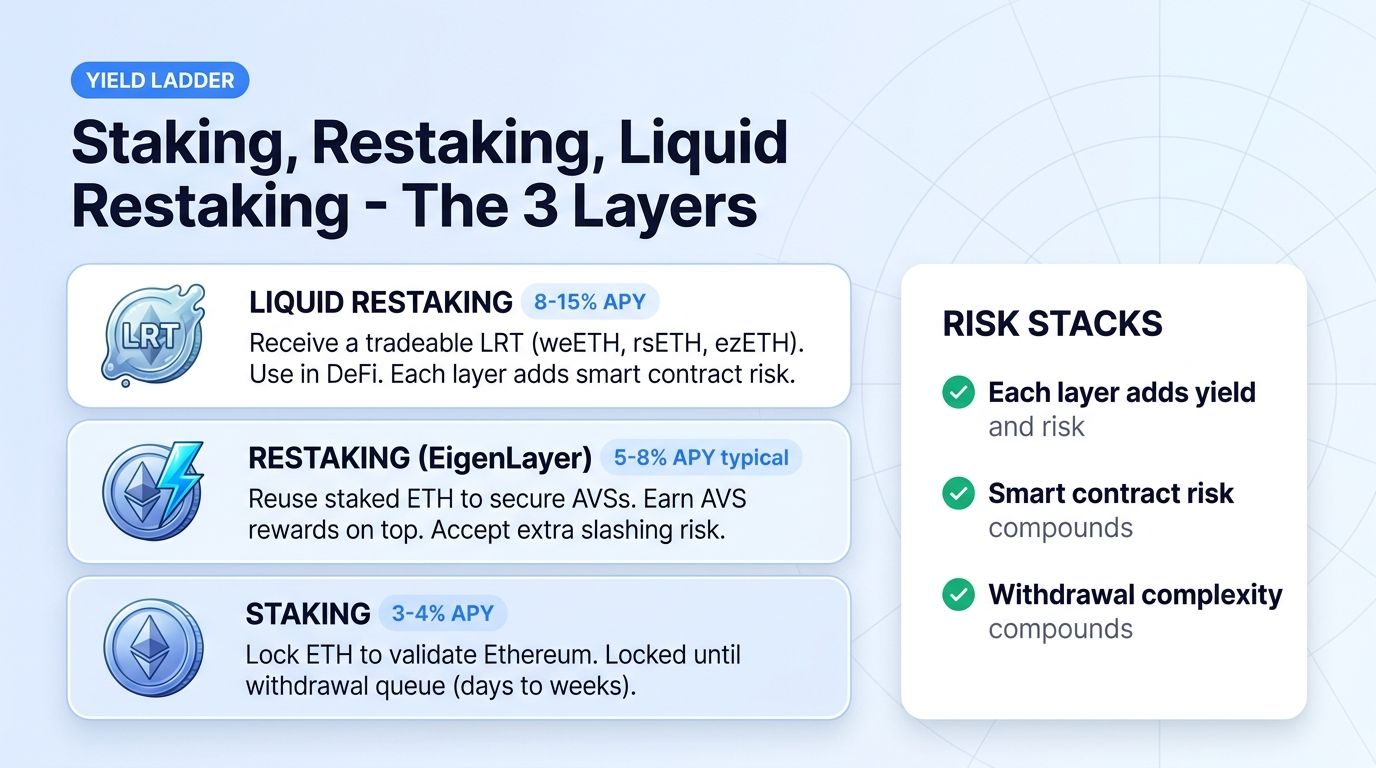
LRT yield is not a single number. It is an aggregate of three distinct layers. Understanding how these layers stack is essential for evaluating whether the return justifies the risk. The structure resembles a layered cake: the bottom is the most stable, while the top adds flavor but also volatility.
Base ETH Staking
The foundation of any LRT is the underlying Ethereum staking reward. When you deposit ETH into an LRT protocol, that ETH is staked on the Ethereum Beacon Chain. This generates the base yield, which currently tracks the network’s average staking APY.
This layer is the most predictable part of the yield. It comes directly from Ethereum consensus rewards and transaction priority fees. It is also the least risky layer, provided the staking protocol itself does not fail. For most LRTs, this base layer accounts for the majority of the total yield, especially when restaking incentives are low.
Restaking Points and Rewards
The second layer comes from restaking protocols like EigenLayer. LRTs take the staked ETH (or its liquid receipt) and delegate it to Actively Validated Services (AVSs). This allows the ETH to secure additional networks, earning extra points or token rewards.
This layer is the primary differentiator for LRTs. It can significantly boost total returns, but it introduces new risks. If an AVS fails or the restaking protocol is exploited, the underlying ETH could be slashed. The yield here is often volatile and depends on the demand for AVS security. Some protocols distribute these rewards immediately, while others accrue them as points for future token airdrops.
Protocol Incentives
The third layer consists of incentives provided by the LRT protocol itself. These are often temporary measures designed to attract liquidity. Protocols may distribute their own governance tokens or stablecoins to users who stake with them.
This layer is the most speculative. Incentives can be generous in the early stages of a protocol’s launch but may dry up quickly. They are not guaranteed and are often funded from treasury reserves. When evaluating an LRT, you must distinguish between yield that is structural (staking + restaking) and yield that is promotional (incentives). The latter should be viewed as a bonus, not a core return.

Comparing Major LRT Protocols
Liquid restaking tokens (LRTs) have fragmented into a diverse ecosystem, each protocol carving out a specific niche through distinct yield strategies and risk profiles. While the underlying mechanism—restaking ETH to secure EigenLayer AVSs—remains constant, the execution varies significantly across leading platforms like EtherFi, Renzo, and Puffer. Understanding these differences is essential for aligning your position with your risk tolerance and yield expectations.
The comparison below outlines the core mechanics of three major LRT protocols. It focuses on their primary yield sources, fee structures, and relative market depth as of early 2026. This data provides a baseline for evaluating which protocol best suits your specific liquidity needs.
| Protocol | Primary Yield Source | Fee Structure | TVL Rank (Est.) |
|---|---|---|---|
| EtherFi (eETH) | EigenLayer AVS + LRT Yield | 0% Protocol Fee | Top 3 |
| Renzo (ezETH) | Restaking + Liquidity Vaults | 10% Performance Fee | Top 3 |
| Puffer (pufETH) | EigenLayer AVS + Node Operations | 0% Protocol Fee | Top 5 |
EtherFi: The Pioneer
EtherFi launched the LRT narrative with eETH, focusing on a straightforward value accrual model. By maintaining a zero-protocol fee structure, EtherFi maximizes the yield passed to stakers, making it a popular choice for those prioritizing pure yield accumulation over complex yield optimization strategies. Its deep liquidity and first-mover advantage provide significant stability, though its yield growth is directly tied to the performance of EigenLayer AVSs.
Renzo: Yield Optimization
Renzo distinguishes itself through its ezETH, which leverages a network of liquidity vaults to optimize yield across multiple restaking protocols. This approach allows Renzo to capture additional yield layers beyond the base EigenLayer returns. However, this optimization comes with a 10% performance fee, which is deducted from the excess yield generated. This structure appeals to users willing to accept slightly higher complexity for potentially higher net returns.
Puffer: Institutional Focus
Puffer’s pufETH targets institutional and high-net-worth participants by emphasizing robust risk management and node operation efficiencies. Like EtherFi, Puffer charges no protocol fee, but its yield composition includes additional components from node operations and strategic AVS selections. This model aims to provide a more resilient yield stream, though it may involve slightly lower liquidity depth compared to the top-tier protocols.
The choice between these protocols often comes down to a trade-off between yield optimization and fee transparency. EtherFi and Puffer offer fee-free structures, appealing to those who want to maximize gross yield. Renzo’s fee-based model offers potential for higher net yields through active management, but requires trust in its vault strategies. As the LRT landscape evolves, these distinctions will remain critical for informed decision-making.

Key Infrastructure Risks to Watch
Liquid restaking tokens (LRTs) promise elevated yields, but that return is not free. It is priced against a specific set of infrastructure vulnerabilities. Gauntlet’s market risk framework identifies four primary attributes that determine whether an LRT protocol can survive market stress: smart contract complexity, slashing exposure, liquidity fragmentation, and depegging risk. Understanding these mechanics is essential for assessing the true risk-adjusted return of any LRT position.
Smart Contract Complexity
LRTs introduce additional layers of code by wrapping restaked assets in liquid derivatives. Each new contract layer increases the attack surface. A vulnerability in the vault, the oracle, or the redemption mechanism can lead to total loss of funds. Unlike simple staking, where the risk is binary (stake or don’t), LRTs require auditing multiple interacting systems. The more complex the architecture, the higher the probability of a critical bug. Always review audit reports from reputable firms and check for active bug bounty programs before allocating capital.
Slashing Risk Exposure
Slashing occurs when a validator misbehaves, resulting in the loss of staked ETH. In liquid restaking, this risk is amplified because your assets are often shared across multiple protocols or networks. If one underlying protocol fails, your entire restaked position may be penalized. Gauntlet notes that slashing risk is not evenly distributed; it depends on the validator selection process and the economic security of the restaked networks. High yields often correlate with higher slashing exposure, as protocols may delegate to less proven validators to maximize returns.
Liquidity Fragmentation
LRTs create a fragmented liquidity landscape. Assets are locked in restaking contracts, while their liquid derivatives trade on various exchanges. This separation can lead to inefficiencies. During market stress, liquidity may dry up in the derivative markets, making it difficult to exit positions without significant slippage. Additionally, if the underlying restaking protocol experiences congestion or delays, the liquidity of the LRT can become trapped. Investors should monitor the depth of order books and the stability of the liquidity pools supporting the LRT.
Depegging Events
A depeg occurs when the LRT’s market price diverges significantly from its net asset value (NAV). This can happen due to market panic, liquidity crunches, or loss of confidence in the underlying protocol. While minor deviations are normal, sustained depegging signals deeper structural issues. Gauntlet’s framework emphasizes monitoring the premium/discount dynamics of LRTs. A shrinking premium or a move into discount often precedes larger sell-offs. Understanding the drivers of these price dislocations helps investors avoid buying at peaks or selling at bottoms during volatile periods.
Warning: High yields often correlate with higher smart contract complexity and slashing risk.
The interplay of these risks defines the risk profile of any LRT. A protocol with low smart contract risk might still suffer from high slashing exposure if it delegates to aggressive validators. Conversely, a highly audited protocol might face liquidity risks if its market adoption is limited. Investors must evaluate all four dimensions together, not in isolation, to make informed decisions about their LRT allocations.
Choosing an LRT Strategy
Selecting the right liquid restaking token (LRT) requires aligning your portfolio with your specific tolerance for risk, liquidity needs, and yield expectations. There is no single best protocol; the optimal choice depends on whether you prioritize capital preservation, maximum yield, or operational flexibility.
Assess Risk Tolerance
LRTs introduce smart contract complexity and restaking risks beyond standard staking. If you are risk-averse, prioritize protocols with audited code, established track records, and conservative validator sets. Avoid experimental protocols with unaudited smart contracts or excessive leverage. For high-stakes allocations, diversify across multiple reputable LRT providers to mitigate protocol-specific failure risks.
Evaluate Liquidity Needs
Liquidity needs dictate how quickly you can exit a position. Some LRTs trade on decentralized exchanges with deep liquidity, while others may have slippage issues during market volatility. If you need immediate access to funds, choose LRTs with high trading volume and tight bid-ask spreads. For long-term holdings, lower liquidity may be acceptable in exchange for higher potential yields.
Compare Yield Expectations
Yield varies significantly across LRTs based on their underlying strategies, such as restaking points, fee sharing, or additional incentives. Use a comparison table to evaluate annual percentage yields (APYs) across providers. Remember that higher yields often correlate with higher risks. Verify that yields are sustainable and not artificially inflated by temporary incentives.
| Factor | Low Risk | High Yield |
|---|---|---|
| Protocol Maturity | Established, audited | Experimental, new |
| Liquidity | High volume, low slippage | Variable, potential slippage |
| Yield Source | Conservative, diversified | Aggressive, concentrated |
Use a Decision Checklist
Before depositing, run through this checklist to ensure your LRT strategy aligns with your goals:
-
Have I audited the smart contract and validator set?
-
Is the liquidity sufficient for my exit timeline?
-
Do I understand the yield source and its sustainability?
-
Have I diversified across multiple protocols?
Clarify whether you prioritize yield, liquidity, or safety. This determines your protocol selection.
Compare LRTs using official sources and audits. Focus on security and transparency.
Deposit a small amount first to test liquidity, yield distribution, and user experience.
No comments yet. Be the first to share your thoughts!