What liquid restaking tokens actually do
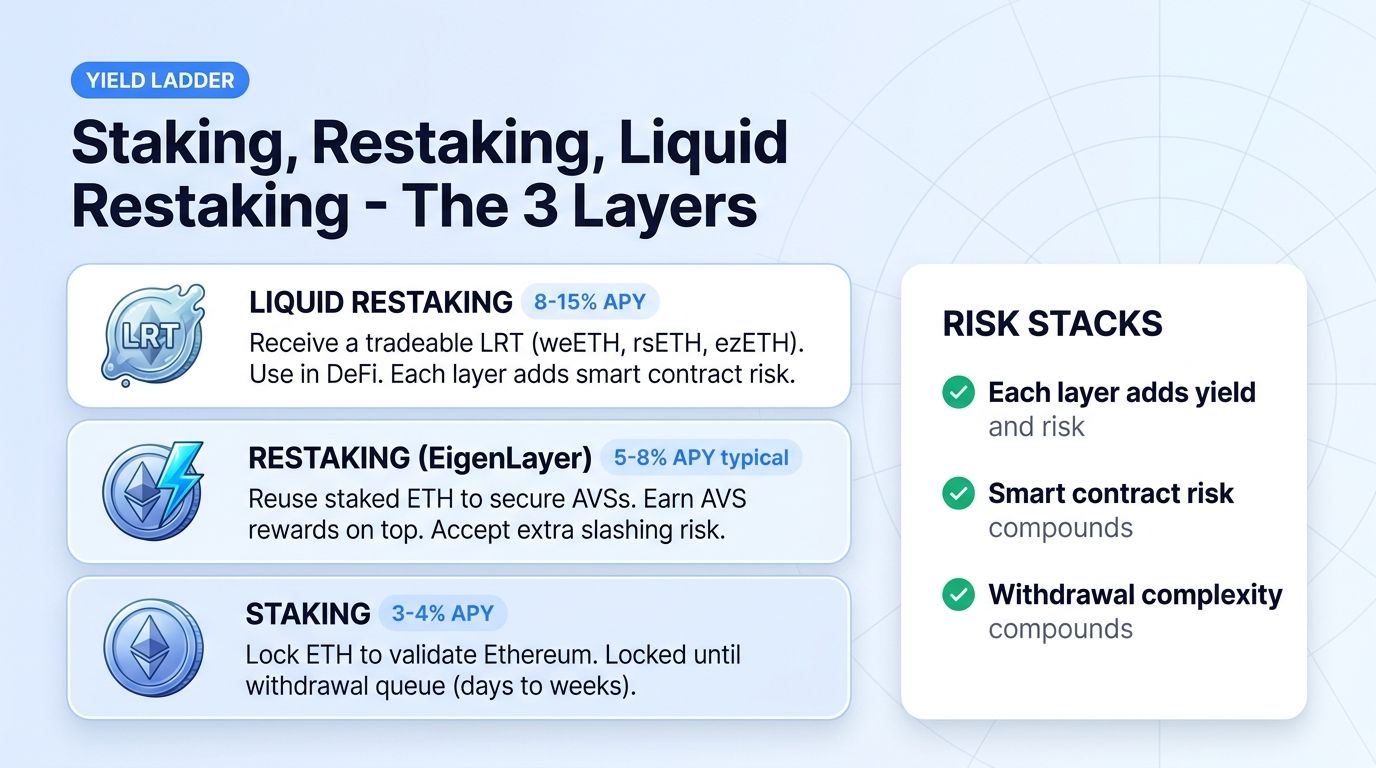
Liquid restaking tokens (LRTs) are digital receipts that prove your assets are securing multiple networks at once. When you stake Ethereum, you lock it up to help validate the chain. With restaking, you take that already-staked ETH and extend its security to other protocols, like oracle networks or bridge systems. This allows the same capital to earn yield from several sources simultaneously.
Think of an LRT as a flexible voucher. Instead of your staked ETH sitting idle, the protocol mints an LRT that represents your position. You can hold this token, trade it, or use it in other DeFi applications while your underlying assets continue to generate rewards. It’s like getting a boarding pass that lets you access multiple lounges without leaving your seat.
The primary appeal is efficiency. You aren’t locking up new capital; you’re leveraging what you already have. However, this convenience comes with trade-offs. If a secondary protocol fails, your restaked assets could be slashed. Understanding this mechanism is essential before allocating funds to any LRT protocol.
Top LRT protocols shaping the market
Liquid restaking tokens (LRTs) have evolved from experimental concepts into the backbone of the restaking economy. These protocols allow users to stake ETH and simultaneously extend that security to other networks, earning yield from both the base layer and the additional services. While the underlying mechanic is simple, the protocols differ significantly in how they manage risk, distribute rewards, and maintain capital efficiency.
The market is currently dominated by a few key infrastructure players that have established deep liquidity and robust risk frameworks. Understanding their specific approaches is essential for evaluating yield sustainability. Below are the leading protocols that are currently shaping the LRT landscape.
EtherFi
EtherFi is widely considered the pioneer of the liquid restaking category. Its flagship product, etherfiETH, allows users to stake ETH and receive a token that represents their position. The protocol’s primary appeal lies in its "Liquid Staking Derivatives" (LSD) model, which integrates seamlessly with existing DeFi ecosystems. By combining liquid staking with restaking, EtherFi offers a dual-yield mechanism that has attracted significant total value locked (TVL).
From a risk perspective, EtherFi relies on a distributed network of node operators to secure the restaked assets. This decentralization helps mitigate the risk of single points of failure. The protocol’s native token, EFI, plays a central role in governance and incentivizes participation in the ecosystem. For investors, EtherFi offers a straightforward entry point into restaking with a proven track record and high liquidity.
Renzo
Renzo Protocol distinguishes itself through its "Restaking Points" system and a highly flexible architecture. Instead of a single token, Renzo offers EZ, its liquid restaking token, which can be easily integrated into various DeFi strategies. The protocol’s innovation lies in its ability to dynamically allocate restaking power across multiple networks, optimizing yield based on real-time market conditions.
Renzo’s risk management framework is designed to handle the complexities of multi-chain restaking. It employs a sophisticated oracle system to monitor the health of underlying node operators and adjust exposure accordingly. This proactive approach to risk has made Renzo a favorite among users who prioritize capital efficiency and yield optimization across different blockchain environments.
Puffer Finance
Puffer Finance addresses a specific pain point in the restaking market: the risk of slashing events. Its unique "Slashing Insurance" feature protects users from potential losses caused by malicious or faulty node operators. PufferETH, its liquid restaking token, is backed by a reserve of ETH that serves as a safety net, providing an extra layer of security for conservative investors.
The protocol also offers a "Puffer Vault" mechanism that allows users to choose their level of risk and reward exposure. By offering customizable risk profiles, Puffer caters to a broader range of investors, from those seeking maximum yield to those prioritizing capital preservation. This flexibility, combined with its insurance mechanism, makes Puffer a compelling option for risk-aware participants.
Kelp DAO
Kelp DAO focuses on simplifying the restaking experience through its rETH token. The protocol emphasizes ease of use and accessibility, allowing users to restake ETH with minimal technical knowledge. Kelp’s infrastructure is designed to be modular, enabling integration with various DeFi protocols and enhancing the utility of rETH.
Risk management at Kelp is handled through a combination of smart contract audits and a decentralized governance model. The protocol regularly updates its risk parameters based on market feedback and performance data. Kelp’s approach prioritizes transparency and community involvement, ensuring that the protocol remains aligned with the interests of its users.
Comparison of Key Metrics
The following table compares the core metrics of these leading LRT protocols. Note that TVL and yield rates are dynamic and subject to market conditions. Always verify current data on the official protocol dashboards before making investment decisions.
| Protocol | TVL (Est.) | Primary Yield Source | Key Risk Feature |
|---|---|---|---|
| EtherFi | High | ETH Staking + Restaking | Distributed Node Operators |
| Renzo | High | Dynamic Allocation | Multi-Chain Oracles |
| Puffer Finance | Medium | ETH Staking + Insurance | Slashing Insurance |
| Kelp DAO | Medium | ETH Staking + DeFi Integration | Modular Risk Parameters |
Where the real yield comes from
Liquid restaking tokens (LRT) don’t create value from thin air. They aggregate rewards from three distinct sources: the base network, restaking incentives, and points programs. Understanding this mix is essential because these sources have different sustainability profiles and risk factors.
Base staking rewards are the foundation. When you stake ETH or BTC, you earn network fees and issuance. This yield is relatively stable but modest, typically ranging from 3-5% for Ethereum and lower for Bitcoin. It represents the floor of your return.
Restaking incentives are the primary driver of LRT yields. By restaking, you provide security to other protocols (Actively Validated Services or AVSs). These protocols pay additional rewards to attract that security. This is where the "yield" premium comes from, but it introduces smart contract risk and slashing risk if the AVS behaves maliciously.
Points and airdrops are the third component. Many LRT protocols offer points for activity, which may convert to future token emissions. This is speculative and non-guaranteed. It can significantly boost APY on paper but carries the risk of the points never materializing into tangible value.
The total yield you see is a composite of these three. A protocol advertising 15% APY might be paying 4% in base rewards, 9% in restaking incentives, and 2% in points. If the restaking demand drops or points expire, your yield could halve overnight.


As an Amazon Associate, we may earn from qualifying purchases.
When evaluating LRT protocols, look at the breakdown of their yield sources. Prioritize protocols with a high proportion of base and restaking rewards over those relying heavily on points. This approach helps you manage expectations and avoid the disappointment of unsustainable yields.
The Infrastructure Risks Behind LRT Yield
Liquid Restaking Tokens (LRTs) offer yield by letting you stake assets like Ethereum and then "restake" them to secure other networks. While this creates multiple layers of value, it also stacks multiple layers of potential failure. If one link in that chain breaks, the entire structure can suffer.
Smart Contract Complexity
LRT protocols are not simple vaults. They involve complex interactions between the base staking layer, the restaking layer, and the LRT issuance mechanism. Every smart contract introduces the possibility of a bug or exploit. Unlike standard staking, where your funds are locked in a well-understood protocol, LRTs often rely on custom code to manage rewards and liquidity. A single vulnerability in this custom logic can lead to total loss of funds. You are trusting not just the underlying asset, but the intricate code that wraps it.
Slashing and Penalty Risks
Restaking allows your assets to secure multiple services simultaneously. This amplifies your rewards but also your exposure to slashing. Slashing occurs when a validator behaves maliciously or goes offline, resulting in a penalty where a portion of the staked assets is destroyed. Because your assets are securing multiple networks, you are vulnerable to slashing events across any of those networks. A single poorly performing validator in the restaking layer can trigger penalties that reduce your overall yield or principal.
De-Pegging and Liquidity Fragility
LRTs are designed to maintain a 1:1 peg with the underlying staked asset plus accrued rewards. However, market dynamics can cause this peg to break. During periods of high volatility or stress, the LRT may trade at a discount as holders rush to exit. This de-pegging risk is compounded by liquidity constraints. If the protocol lacks sufficient liquidity to redeem LRTs at face value, you may be forced to sell at a loss. Gauntlet’s risk framework highlights this as a critical attribute, noting that liquidity depth is a primary determinant of whether an LRT can withstand market shocks.
How to build a safe LRT strategy
Building a safe liquid restaking strategy requires treating yield as a function of risk management, not just protocol selection. Restaking allows you to extend the security of your base staked assets to support other networks, but it introduces new layers of smart contract and economic risk. To protect your capital, you need a systematic approach that prioritizes protocol mechanics and continuous monitoring over chasing the highest APR.

Before allocating capital, review the protocol’s security posture. Look for third-party audits from reputable firms and check if the team publishes a risk framework. Gauntlet’s Liquid Restaking Token (LRT) Market Risk Framework provides a standard for evaluating attributes like smart contract risk and economic resilience. If a protocol cannot clearly explain how it handles slashing or depegging events, treat it as a red flag.

Never concentrate your restaking exposure in a single token or protocol. Spread your assets across different LRT providers to mitigate the risk of a single point of failure. This diversification ensures that a smart contract exploit or economic crisis in one protocol does not wipe out your entire position. Aim to hold positions in at least three distinct, well-audited LRT protocols.
High yields often signal high risk or unsustainable incentive structures. Regularly check the protocol’s health metrics, such as the ratio of staked assets to total supply and the source of yield. If yield is primarily driven by short-term incentives rather than genuine network demand, it may collapse quickly. Use official protocol dashboards to track these metrics weekly.

Stay informed by setting up alerts for governance proposals, smart contract upgrades, or slashing events on the underlying networks. Liquid restaking involves complex interactions between multiple networks; a change in one layer can impact your returns in another. Proactive monitoring allows you to exit or rebalance positions before risks materialize into losses.
By following these steps, you can construct a resilient LRT portfolio that balances yield generation with capital preservation. The goal is not to maximize returns at all costs, but to ensure your strategy can withstand the inherent volatility of the restaking ecosystem.
Frequently asked questions about LRT yield
What is an LRT in crypto?
Liquid Restaking Tokens (LRTs) are digital receipts representing your restaked position. When you restake, you extend the security of your base network assets to other protocols. The LRT allows you to hold a liquid token that tracks this value while you earn yield, rather than locking your assets away without liquidity.
How is yield generated from LRTs?
Yield comes from two sources: the base staking rewards from the underlying network (like Ethereum) and additional rewards from the protocols you restake to. Protocols pay these rewards for the security services your assets provide. Think of it as earning rent on your security capital from multiple tenants simultaneously.
What are the main risks of LRT yield?
The primary risk is smart contract vulnerability. Since LRTs involve multiple layers of code and delegated security, a bug in any protocol can lead to total loss. Additionally, slashing events can occur if the validator operators misbehave, potentially reducing your principal. Always review the audit history of the specific protocol before depositing.
No comments yet. Be the first to share your thoughts!